


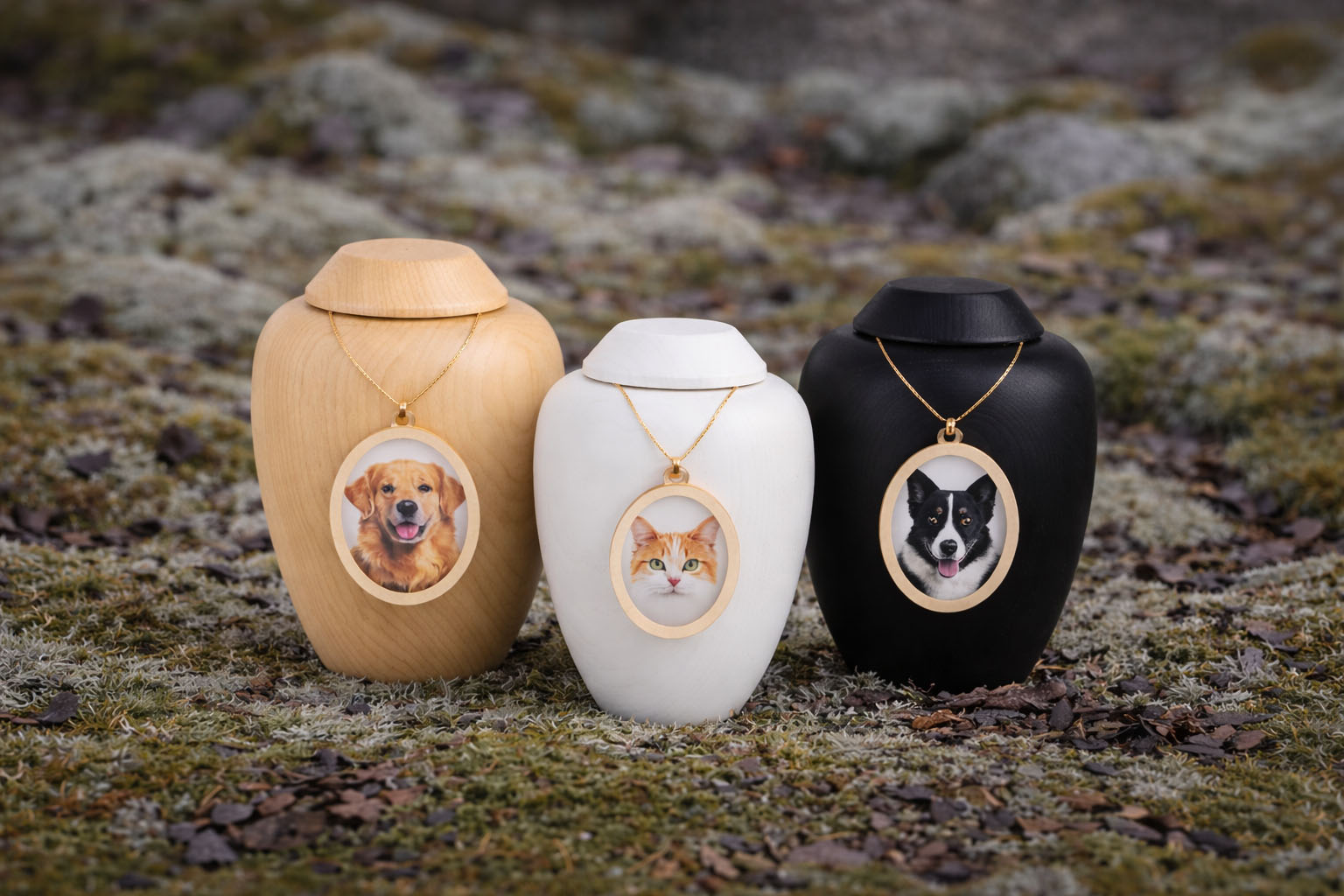
A pet can be buried in your backyard, in a pet cemetery, or cremated and the ashes placed in a variety of locations. In Finland, burying a pet on your own property is permitted under certain conditions, but cremation has become an increasingly popular alternative because it offers more flexibility in how you choose to honor your pet’s memory. Below, we cover all the key questions about pet burial, from practical guidelines to ways of remembering your companion.
Can you bury a pet in your backyard?
Yes, in Finland you can generally bury a pet on your own property. The most important requirements are that the burial site is located a sufficient distance from bodies of water, wells, and neighboring property boundaries. The pet must also be buried deep enough to prevent any hygiene-related issues. Individual municipalities may have their own specific guidelines, so it’s worth checking local regulations in advance.
If you live in an apartment building or don’t own your own property, a backyard burial is naturally not an option. In that case, pet cemeteries and crematoriums are the available alternatives. Renters should also keep in mind that burying a pet on the property effectively requires the owner’s permission.
What options are available for burying a pet?
There are several options for laying a pet to rest: burial on your own property, burial in a dedicated pet cemetery, or cremation through a crematorium. After cremation, the ashes can be kept in an urn at home, scattered in nature, or buried in a chosen location. Each option suits different life circumstances and personal values.
- Backyard burial: Suitable for homeowners when the site meets hygiene and distance requirements.
- Pet cemetery: A dedicated burial ground for pets, often with the option of a marked grave.
- Cremation: Having your pet cremated through a crematorium offers the greatest flexibility in how you honor their memory. The ashes can be kept at home in a wooden pet urn, buried, or scattered.
Cremation has grown significantly in popularity because it is also suited to those living in cities and makes it possible to keep your pet’s memory close in everyday life.
How does pet cremation work in practice?
Pet cremation takes place at an animal crematorium, where the pet is brought after death. The process is straightforward: the animal is cremated and the ashes are returned to the owner in an agreed form, most commonly in an urn or a separate container. The entire process typically takes anywhere from a few days to a week, depending on the crematorium’s schedule.
Cremation can be arranged as an individual cremation, in which case you are guaranteed to receive your own pet’s ashes back, or as a communal cremation, which is a more affordable option but does not result in ashes being returned. Most owners choose individual cremation when preserving the memory is important to them.
Crematoriums can be found in most larger towns and cities, and many veterinary clinics can help with the arrangements. It’s worth asking your vet for recommendations on service providers in your area.
What is the most eco-friendly way to bury a pet?
The most environmentally sustainable choice is a wooden urn made from renewable, domestically sourced wood. The greatest environmental benefit of wood is its ability to biodegrade naturally: if the urn is buried in the ground, it will break down over time and become part of the soil, leaving no lasting trace in the environment. Unlike plastic or metal, wood is a renewable natural resource whose production places a far lighter burden on the environment.
Being eco-friendly is not only about what happens at the moment of burial. It also concerns where the materials come from and how the product is made. A wooden urn is crafted from renewable raw timber, and its surface is finished with wax for protection and beauty. The wax breaks down more slowly than the wood itself, but only a very small amount is used in the product, so it does not significantly diminish the urn’s overall environmental credentials.
By comparison, many plastic or metal urns do not biodegrade at all, and their production consumes non-renewable natural resources. Wood, on the other hand, is an ethically sound material that returns to nature of its own accord.
How deep should a pet be buried?
A pet’s grave should be at least approximately one meter deep to prevent hygiene issues and to stop other animals from digging it up. For smaller pets, a shallower grave may suffice, but the general guideline is that there should be at least 60 centimeters of soil between the surface and the pet. The larger the pet, the deeper the grave should be.
Location also matters: the grave should not be near groundwater areas, wells, or bodies of water. It is also advisable to avoid areas where the soil is very wet or prone to flooding. Dry, well-draining soil is the best option.
How can you create a meaningful memorial after burial?
The most meaningful memorials are often those that are ongoing rather than limited to the day of burial. After cremation, a wooden urn placed on a shelf, a windowsill, or a dedicated memorial spot in the home keeps your pet’s memory alive in everyday life. A wooden urn doesn’t require any special setting — it fits naturally into the home environment.
Creating a lasting memorial also comes down to how the urn is chosen. A high-quality wooden urn is both aesthetically beautiful and durable in its materials. It is not merely a container, but an object that honors your pet’s memory in a tangible and visible way.
The size of the urn should be chosen based on your pet’s weight. As a general guideline, approximately one liter of capacity is needed for every 10–15 kilograms of body weight. If you are between two sizes, it’s better to choose the slightly larger urn to be safe.
- Small pets (under 10 kg): 0.5 l
- Medium pets (10–20 kg): 1.0 l
- Medium-large pets (20–30 kg): 1.5 l
- Large pets (over 30 kg): 2.0 l
At Kuurna Design, we craft wooden urns in four sizes for exactly this purpose. Each urn brings together Finnish joinery, Scandinavian design, and an ecological approach to materials. The urns are made using Finnish woodworking traditions that combine handcraft with precision manufacturing. Every wooden urn is finished with wax, used in only a small quantity, making each piece both beautiful and environmentally considerate. A wooden urn works equally well as part of your home décor or, if you wish, for burial — as wood biodegrades naturally in the ground. Get in touch to learn more about our urn options.